Salt Lake City sits at the convergence of forces that test every roofing material on the market. Summer temperatures regularly exceed 95°F, pushing surface temperatures on dark roofing materials past 160°F. Winter brings sustained freezing, heavy snow loads, and relentless freeze-thaw cycling. And every spring and summer, the Wasatch Front delivers hailstorms that can shred materials not engineered for impact.
Choosing a roofing material here is not simply about aesthetics or price per square. It is about understanding how each material responds to Salt Lake City's specific combination of UV intensity, thermal swing, moisture cycling, wind, and hail — and selecting the product that delivers the longest service life with the fewest callbacks. This guide breaks down how the most common residential roofing materials perform under Wasatch Front conditions, so you can make a decision built on data rather than assumptions.
The Five Climate Demands of the Wasatch Front
Every roofing material installed in the Salt Lake Valley must stand up to five distinct environmental forces — and it is the combination of all five, not any single factor, that separates materials that last from materials that fail early.
UV and Solar Intensity
At 4,300 feet of elevation and roughly 222 sunny days per year, Salt Lake City exposes roofing to significant ultraviolet radiation. UV breaks down the petroleum-based compounds in asphalt shingles, accelerating granule loss and surface cracking. South- and west-facing roof planes bear the heaviest exposure and typically age 3-5 years faster than north-facing slopes on the same structure. Materials with UV-stabilized granules or inherent UV resistance — metal, composite, tile — perform measurably better on these exposures.
Thermal Cycling
The Salt Lake Valley regularly produces 50-60°F daily temperature swings during spring and fall shoulder seasons, and winter inversions can shift temperatures dramatically within hours. Each cycle forces roofing materials to expand and contract, stressing fastener connections, laps, and sealant strips. Over a 25-year roof life, this translates to thousands of expansion-contraction cycles — far more than roofs in temperate climates experience. Materials with SBS-modified asphalt or inherent flexibility (metal, rubber-modified composites) handle this thermal movement without cracking or splitting.
Freeze-Thaw and Moisture
Salt Lake City averages 54 inches of snow annually, and valley-floor roofs commonly experience 80-100 freeze-thaw cycles per winter. Each cycle drives moisture deeper into porous materials and widens micro-cracks in rigid ones. Any material installed here must either shed moisture completely (metal) or resist absorption under repeated cycling (SBS-modified shingles, composite slate, engineered shake). Porous natural materials — untreated wood shake, soft natural slate — degrade measurably faster under Salt Lake City's freeze-thaw regime than their manufacturer warranties suggest.
Hail
The Wasatch Front is among the highest hail-frequency zones in the western United States. Storms producing 1-inch to golf-ball-size hail hit the valley multiple times annually, and the east bench and foothill neighborhoods from the Avenues through Millcreek are particularly exposed to orographic hail cells that build against the mountains. Class 4 impact-rated materials (UL 2218) resist fracturing under a 2-inch steel ball dropped from 20 feet. Materials without impact ratings — three-tab shingles, natural slate thinner than ¾ inch, wood shake — sustain functional damage from hailstones that Class 4 products shrug off.
Wind
East-bench canyon winds routinely gust to 60-80 mph during fall and winter downslope events. The benches above Foothill Drive, Emigration Canyon, Parley's Canyon, and the east-facing neighborhoods from Federal Heights through Olympus Cove take the hardest hits. Any material installed on these exposures must carry a wind rating of at least 110 mph (ASTM D7158 Class H or equivalent). Six-nail patterns on shingles, mechanically locked standing seam panels, and proper starter-strip adhesion are not optional upgrades in these zones — they are baseline requirements.
Material-by-Material Performance Breakdown
Three-Tab Asphalt Shingles
Three-tab shingles remain the lowest-cost option at $8,000-$14,000 for an average Salt Lake City home, but they are also the lowest-performing material under Wasatch Front conditions. The single-layer construction offers no impact resistance, limited wind performance (typically 60-70 mph), and accelerated granule loss under UV exposure. Realistic service life in the Salt Lake Valley is 15-20 years — well short of the 25-year warranties these products carry. For homeowners planning to sell within 5-10 years, three-tab shingles represent a functional budget option. For anyone planning to stay, the math favors investing in a higher-performing material.
Architectural Laminate Shingles
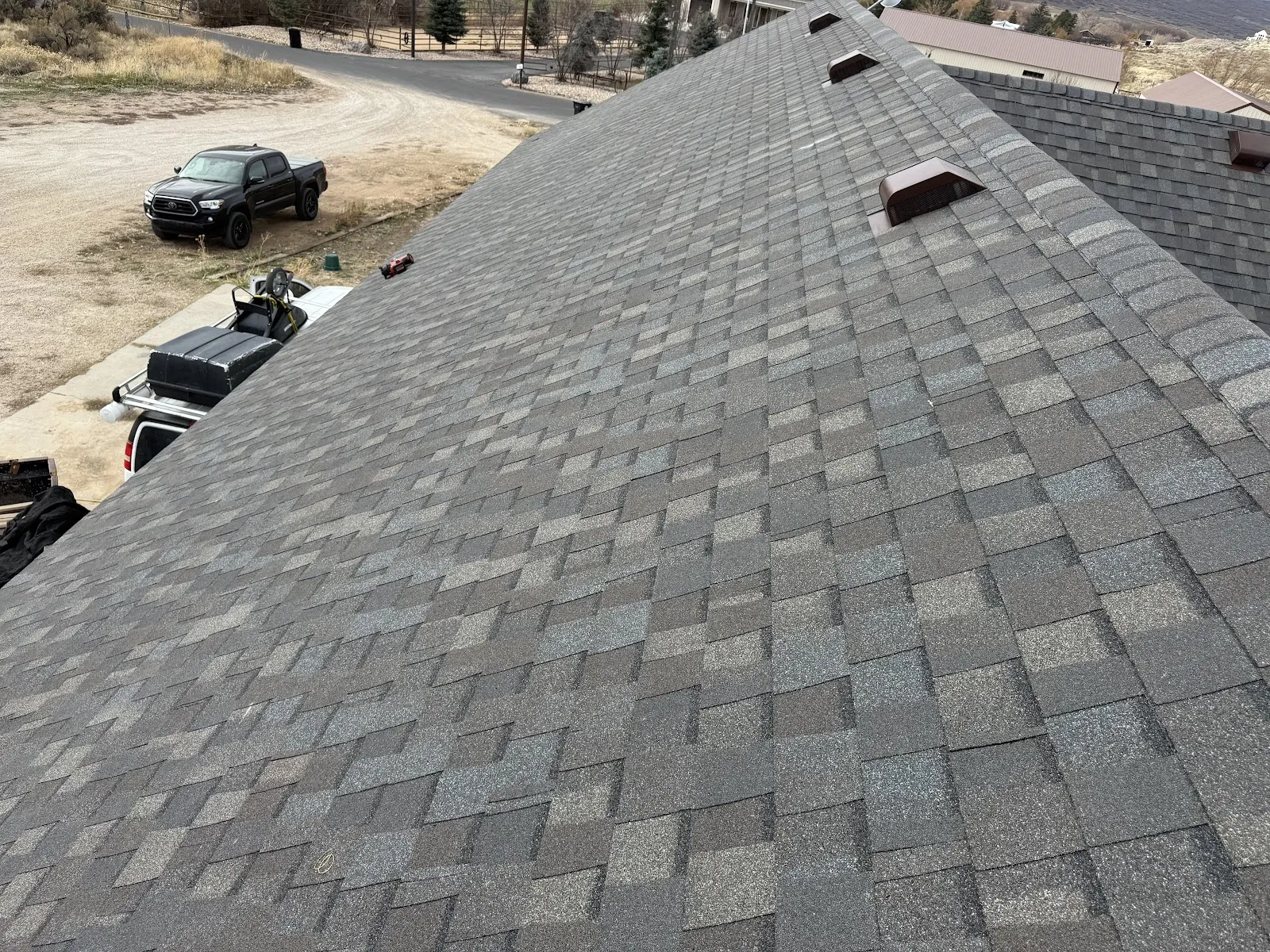
Architectural laminates represent the strongest value proposition for most Salt Lake City homes. The multi-layer construction provides dimensional appearance and significantly better performance across every climate metric that matters here. Premium architectural shingles with SBS-modified asphalt — products like Owens Corning Duration STORM, CertainTeed Landmark PRO, or GAF Timberline HDZ — deliver Class 4 impact resistance, 130-mph wind ratings, and improved flexibility through freeze-thaw cycling. Typical installed cost runs $14,000-$24,000 depending on roof complexity. Realistic service life under Wasatch Front conditions is 25-35 years. Insurance premium discounts for Class 4 products typically recoup the upgrade cost over the first 8-12 years.
Designer and Specialty Shingles
Designer shingles replicate the appearance of natural slate, cedar shake, or heavy wood shingle at a fraction of the weight and maintenance. Products like GAF Camelot, CertainTeed Grand Manor, or Owens Corning Berkshire use heavy-weight fiberglass mats and thick asphalt layers to create dimensional profiles that complement Salt Lake City's historic and character-driven neighborhoods. Performance matches or exceeds standard architectural laminates — Class 4 impact, 130-mph wind ratings, enhanced UV protection — with a service life of 30-40 years. Installed cost ranges from $20,000-$35,000. For homes in the Avenues, Federal Heights, Yalecrest, or South Temple where architectural character matters, designer shingles deliver the aesthetic of premium natural materials with the climate performance Salt Lake City demands.
Standing Seam Metal
Standing seam metal roofing is the top-performing material for Salt Lake City's climate by nearly every measure. Steel or aluminum panels with mechanically locked seams shed snow and ice effectively, carry wind ratings exceeding 140 mph, and resist hail impact without fracturing. Metal is inherently impervious to freeze-thaw cycling and UV degradation, with realistic service life of 40-60 years under Wasatch Front conditions. Reflective coatings reduce cooling loads in summer, and the smooth surface prevents ice dam formation that plagues shingle roofs during inversion events. Installed cost ranges from $22,000-$40,000 for steel, higher for copper or zinc. The longer service life — often two to three times that of architectural shingles — makes metal the lowest total cost of ownership for homeowners who plan to stay in their home long-term.
Composite Slate and Shake
Composite products — engineered from polymer, rubber, or fiber cement — replicate the appearance of natural slate and wood shake with dramatically better climate resistance. Products like DaVinci Roofscapes, Brava Roof Tile, and EcoStar deliver Class 4 impact resistance, fire ratings of Class A, and dimensional stability through thousands of freeze-thaw cycles. These materials weigh significantly less than natural stone, eliminating the structural reinforcement that real slate often requires. Service life ranges from 40-50 years. Installed cost runs $25,000-$45,000 depending on product and roof complexity. For Salt Lake City homes where the look of natural slate or shake is essential — particularly in historic districts or established neighborhoods — composites deliver the aesthetic without the climate vulnerabilities of natural materials.
Natural Slate
Genuine quarried slate remains the longest-lasting roofing material available, with properly installed roofs exceeding 75-100 years. However, Salt Lake City's freeze-thaw regime is harder on slate than many homeowners expect. Soft slates (S-1 classification) absorb moisture and can delaminate within 30-40 years under aggressive freeze-thaw cycling. Only hard, dense slates (S-1 or better from proven quarries — typically Vermont, Pennsylvania, or imported Welsh slate) perform to their full potential here. Weight is the other consideration: genuine slate weighs 800-1,500 pounds per square (100 sq ft), requiring structural verification and often reinforcement. Installed cost starts at $40,000 and can exceed $80,000 for complex rooflines. Natural slate makes sense for landmark homes where authenticity is non-negotiable and the structure can support the load.
Ventilation: The Performance Multiplier
No roofing material performs to its potential without proper attic ventilation, and this is where many Salt Lake City reroofing projects fall short. During summer, an unventilated attic can reach 150-160°F, baking shingles from below while the sun bakes them from above. This double heat load accelerates aging at roughly twice the normal rate. In winter, warm attic air melting snow from below creates ice dams at the eaves — the number-one cause of winter roof leaks in the Salt Lake Valley.
Proper ventilation requires balanced intake (soffit vents) and exhaust (ridge vent, box vents, or powered vents) sized to the attic square footage. The minimum standard is 1 square foot of net free area per 150 square feet of attic floor — or 1:300 with a vapor barrier and balanced intake/exhaust. Any reroofing project is the ideal time to upgrade ventilation because the deck is already exposed. Skipping this step to save $500-$1,500 on a $20,000+ investment is the single most common mistake homeowners make during reroofing.
Underlayment and Ice Protection
The underlayment beneath your roofing material is the last line of defense against water intrusion, and Salt Lake City's climate demands more than the minimum code requirement. Standard 15-lb felt paper offers basic water resistance but degrades under UV exposure if left uncovered and provides limited protection during wind-driven rain events.
Synthetic underlayment — products like GAF FeltBuster or CertainTeed DiamondDeck — provides superior tear resistance, UV stability, and faster installation coverage. For Salt Lake City homes, we recommend synthetic underlayment across the entire deck, not just the code-minimum eave and valley areas. Ice and water shield membrane (self-adhering rubberized asphalt) is essential at all eaves, valleys, sidewall transitions, and around penetrations. Utah code requires ice barrier at least 24 inches past the interior wall line at eaves — but extending coverage to 36-48 inches provides meaningfully better protection during heavy snow years and inversion-driven ice dam events.
Cost, Lifespan, and Total Value
The initial price of roofing material tells you almost nothing about its true cost. Total cost of ownership — material, installation, maintenance, and replacement over a 50-year horizon — reveals which materials actually deliver value and which create recurring expense.
Consider a straightforward comparison on a 2,000-square-foot Salt Lake City home. Three-tab shingles at $11,000 lasting 18 years require three installations over 50 years: approximately $33,000 total. Architectural laminates at $18,000 lasting 30 years require two installations: approximately $36,000 total — slightly more in raw dollars but with dramatically better performance and curb appeal for the entire period. Standing seam metal at $30,000 lasting 50+ years requires one installation: $30,000 total, with virtually no maintenance and the best climate performance available.
When you factor in insurance premium discounts (typically $200-$500 per year for Class 4 impact-rated materials), the math shifts further toward premium products. Over 30 years, insurance savings alone can total $6,000-$15,000 — enough to close most of the gap between a budget material and a premium one.
Frame Roofing Utah's Approach
We specify roofing materials based on your home's actual conditions — not manufacturer marketing and not whatever product happens to carry the highest margin. Every reroofing project begins with a detailed inspection that maps your roof's orientation, slope, wind exposure, ventilation performance, and structural capacity. That data drives our material recommendation.
We install premium architectural laminates, standing seam metal, designer shingles, and composite products — all with manufacturer-specified fastening patterns, underlayment systems, and ventilation configurations. Every project includes ice and water shield at all critical transitions, synthetic underlayment across the full deck, and ventilation verification before we close the roof.
Uncompromising standards and exacting specifications mean your roof performs to its full rated life — not just its warranty minimum. That is the difference between a roof that looks good on installation day and a roof that still performs flawlessly fifteen winters later.