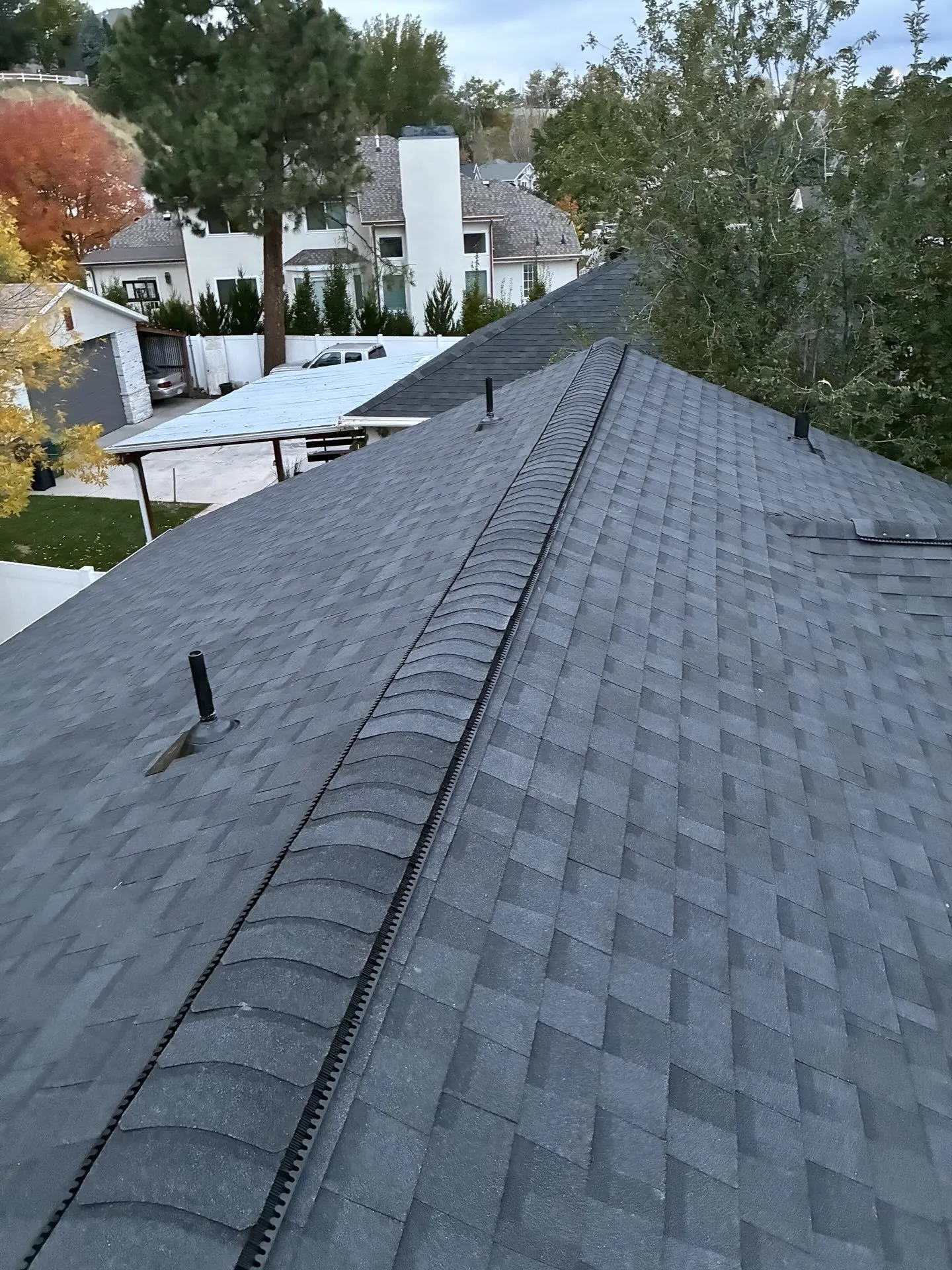
QUICK ANSWER: Davis County — specifically Bountiful, Centerville, Farmington, and the East Bench of Kaysville — sits inside a geographic wind corridor that funnels east-canyon winds down the Wasatch slope and accelerates them to 70 to 100+ mph several times per year. These east winds (meteorologists call them downslope or Foehn winds) are the same mechanism that produces Santa Ana winds in California. The result: Davis County roofs take more lifetime wind damage than any other Wasatch Front community, and the only roofs that consistently survive are standing seam metal or Class H (130 mph) architectural shingles installed with a 6-nail pattern.
Any local will tell you: the wind in Bountiful is different. It is not just stronger — it is directional, persistent, and comes in bursts that can flip trampolines, peel fence panels, and take ridge caps off roofs in a single afternoon. The National Weather Service officially identifies the Wasatch east bench from Centerville through Kaysville as a high-wind zone. Local data makes it specific: Centerville recorded a 102 mph gust on December 1, 2011. Bountiful has logged multiple 70+ mph events in the past three winters. Farmington canyon winds regularly exceed 60 mph during November-through-February windstorm cycles.
This guide explains why Davis County wind is uniquely destructive, what it does to roofs specifically, and the three construction specifications that separate roofs that survive this corridor from roofs that fail every few years. If you own a home in Bountiful, Centerville, Farmington, Kaysville, or Layton's east bench, the next storm is a matter of when, not if.
Why Davis County Wind Is Uniquely Destructive
The wind corridor that runs from Centerville through North Salt Lake is created by a specific terrain mechanism. East winds aloft — moving westward from Wyoming or northeastern Utah — encounter the Wasatch Range and are forced up and over the ridgeline. As they descend the west side of the range, two things happen. First, the air compresses as it moves from higher to lower elevation, which heats and accelerates it. Second, the air is channeled through specific canyon mouths (Weber Canyon, Farmington Canyon, Parrish Creek) that act like nozzles, further accelerating the flow.
The homes sitting directly downslope of these canyon mouths — Bountiful's east bench, Centerville's upper neighborhoods, Farmington below the canyon, Kaysville's Mutton Hollow area — receive the full compressed-and-channeled wind. Speeds that would be 30 mph at higher elevations arrive at roof-height as 60 to 100 mph gusts. This is the same physics as Santa Ana winds, Chinook winds, and Alpine Foehn winds — the Wasatch just happens to be one of the most consistent downslope wind generators in the Intermountain West.
Davis County Wind Events — Historical Record
Dec 1, 2011: 102 mph peak gust in Centerville; widespread roof damage across Davis County, state of emergency declared.
Sep 8, 2020: 112 mph gust recorded at Farmington; catastrophic tree and roof damage from Davis to Weber County.
Winter 2023-24: Multiple 70-85 mph events across Bountiful and Centerville.
Jan-Feb 2026: Three separate windstorms with gusts exceeding 65 mph along the Davis bench.
What Davis County Wind Does to Roofs
Wind damage on Davis County roofs follows a predictable pattern that differs from the random damage typical of thunderstorm-driven wind events in other parts of Utah. The east-wind direction hits the rear roof plane of homes with eastern exposure first and hardest — so damage clusters on specific planes rather than being random across the roof.
The Top Five Davis County Failure Points
1. Ridge cap shingles. Ridge caps are exposed on both sides and always fail first. After a 70+ mph event, expect 20 to 50% of ridge caps to be lifted, rotated, or missing on roofs over 8 years old. Every Frame Roofing Utah post-storm inspection in Centerville after a major wind event finds ridge cap damage.
2. East-plane field shingles. Shingles on east-facing slopes take direct hits from canyon winds. The seal strip breaks, the shingle lifts and flaps, and depending on age, either tears free or reseats imperfectly with the seal compromised. Reseated shingles look fine from the ground but leak within a year.
3. Gable end overhangs. Gable ends without proper structural bracing flex under wind load and can pull the fascia and rake boards loose. If the roof deck edge is not properly secured, high winds can lift the entire roof edge.
4. Flashing and pipe boots. Wind-driven rain is forced horizontally and upward, exactly the direction flashing is not designed to shed water. Pipe boots crack, chimney flashing pulls away, and sidewall step flashing separates.
5. Gutter systems. Strong east winds hitting west-facing eaves drive airflow up under the drip edge. Gutters pull forward, fascia damage accumulates, and ice dam risk increases the following winter.
The Three Specifications That Separate Surviving Roofs From Failing Roofs
Every roof that has survived multiple Davis County windstorms without major damage shares three construction specifications. These are not upgrades — for Davis County, they should be considered code-minimum.
Specification 1: Class H Shingles or Standing Seam Metal
Wind ratings on shingles run from Class A (60 mph) to Class H (150 mph). Most Utah roofs are installed with Class D shingles rated for 110 mph — fine for most of the Wasatch Front, borderline for Davis County. For Bountiful, Centerville, and Farmington homes, Class H shingles (130-150 mph rated) are the minimum. CertainTeed Landmark ClimateFlex, GAF Timberline HDZ, and Owens Corning Duration STORM all carry Class H ratings.
Standing seam metal roofing is the gold standard for Davis County. Concealed-fastener standing seam panels are mechanically locked at each seam and rated to 140+ mph. Properly installed, a standing seam roof has no loose edges, no exposed fasteners to back out, and no ridge caps to lift. It is the single best long-term decision a Davis County homeowner can make.
Specification 2: 6-Nail Pattern with Hand-Sealed Edges
Standard shingle installation uses 4 nails per shingle. Manufacturer wind-rating warranties almost always require 6 nails per shingle for the higher wind classes. In Davis County, 6-nail is non-negotiable regardless of shingle class. Additionally, hand-sealing the rake (gable) and eave edges with asphalt cement creates a mechanical bond that prevents the first-row lift that causes cascading field shingle failures.
Specification 3: Ice-and-Water Shield Over Full Deck in High-Wind Zones
International Residential Code requires ice-and-water shield on eaves, valleys, and penetrations. For Davis County wind-corridor homes, Frame Roofing Utah recommends full-deck ice-and-water shield — not synthetic felt, but the full peel-and-stick membrane across the entire roof deck. This turns the roof deck into a secondary water barrier: even if shingles blow off in a 90 mph gust, the deck remains watertight until repairs can be scheduled.
What Bountiful, Centerville & Farmington Homeowners Should Do This Spring
If you live in Davis County's wind corridor, the spring is the right window to assess your roof and plan for the next windstorm cycle. Three actions to take this spring:
- Schedule a post-winter inspection. Every Davis County roof should be professionally inspected after the November-February wind season. Frame Roofing Utah's inspections are free, take 20 to 30 minutes, and produce a photo-documented condition report.
- Review your homeowners insurance wind coverage. Check your declarations page for a separate wind/hail deductible. Davis County homes frequently carry 1 to 2 percent wind deductibles — on a $650,000 home, that is $6,500 to $13,000 before coverage kicks in.
- If your roof is over 12 years old, plan replacement on your terms. Waiting for a windstorm to force an emergency replacement means paying retail prices in a surge market with crews booked 6 weeks out. Planned replacement in spring or early summer gives you material selection, scheduling control, and a clear path to Class H or standing seam.
Why Local Matters More in Davis County
Every winter, after Davis County windstorms, out-of-state storm chaser companies flood Bountiful and Centerville neighborhoods with door-to-door sales. They offer aggressive sign-up incentives, complete work quickly with traveling crews, and leave the state before warranty issues surface. The problem is specific to Davis County: warranties are only as good as the contractor who stands behind them, and Davis County roofs will face another major windstorm within 12 to 24 months. A contractor that is not physically present in Utah cannot honor a warranty on a roof that is going to be tested repeatedly.
Frame Roofing Utah is based in Heber City and serves all of Davis County directly. Every Davis County project includes a 10-year workmanship warranty backed by a licensed Utah business that will still be operating — and responsive — the next time the canyon winds top 70 mph. Call 435-292-8802 or schedule your free inspection online.
Sources & References
- National Weather Service — Salt Lake City — Davis County wind corridor advisories and event records
- Deseret News — Utah — Historical Davis County windstorm coverage
- National Roofing Contractors Association — Wind damage identification and Class H specifications
- Utah Division of Professional Licensing (DOPL) — Contractor verification
- International Code Council — IRC high-wind zone installation requirements