QUICK ANSWER: A complete Utah roof replacement quote should itemize seven things: tear-off and disposal, decking inspection with replacement allowance, underlayment plus IRC R905.1.2 ice-and-water shield, shingles and ridge cap, flashing and pipe boots and vents, labor and cleanup with magnetic-sweep, and permit plus workmanship warranty terms. A typical 30-square Wasatch Front architectural-shingle replacement runs $12,000 to $18,000 in 2026 dollars. Quotes missing the underlayment, flashing, or permit line items are change-order ambushes waiting to happen. Frame Roofing Utah is licensed, insured, BBB Accredited (A+), and provides written line-item PDF estimates within 48 hours of inspection. Call 435-302-4422.
Why Most Utah Quote Comparisons Fail
A Utah roof replacement quote is a line-item breakdown of materials, labor, overhead, and warranty terms a contractor commits to for removing and replacing your roof. But most homeowners getting bids cannot actually compare them apples-to-apples — Contractor A's $14,000 estimate and Contractor B's $11,500 estimate may not be quoting the same scope of work. Understanding what each line item means is the difference between picking the lower price and picking the lower total cost.
On Reddit's r/Roofing, the most common Utah-flavored questions are exactly this confusion playing out: "Is $72,000 reasonable?" "What does RFG300 mean on my insurance estimate?" "What's a reasonable Overhead and Profit percentage?" "Is this quote standard?" The answers always depend on the specific scope behind the headline number, which is what this guide unpacks.
We see three failure modes regularly when homeowners compare quotes side-by-side. First, missing line items — a quote that omits the underlayment or flashing line will be cheaper but invariably leads to mid-project change orders. Second, vague labor allowances rather than itemized labor — "includes labor" is not a quote, it's a deposit-with-padding structure. Third, deposit and payment structures that front-load risk to the homeowner. We'll cover all three.
The 7 Line Items Every Utah Quote Should Have
1. Tear-off and disposal. This covers removing existing shingles down to the deck, hauling debris, and landfill fees. On a 30-square Wasatch Front home, expect $1,500 to $2,800. Multi-layer tear-offs (asphalt over original wood shake, common on pre-1975 homes) run 30 to 60 percent higher because each layer requires its own disposal pass. A quote that bundles tear-off into "materials and labor" without a discrete number is hiding pricing pressure here. Utah landfill tipping fees vary by county — Salt Lake County and Utah County are roughly equivalent; Wasatch and Summit Counties charge slightly more.
2. Decking inspection and replacement allowance. When tear-off exposes the OSB or plywood sheathing, hidden rot, delamination, or framing issues become visible. The quote should reserve $80 to $120 per 4×8 sheet for replacement and specify a procedure for change orders if more sheathing needs replacement than allowance covers. A quote that says "$0 decking allowance" or "decking included" without a specified per-sheet rate is setting up a change-order ambush after demolition starts. On 30-plus year old Utah homes, budget for 2 to 8 sheets of decking replacement as a baseline.
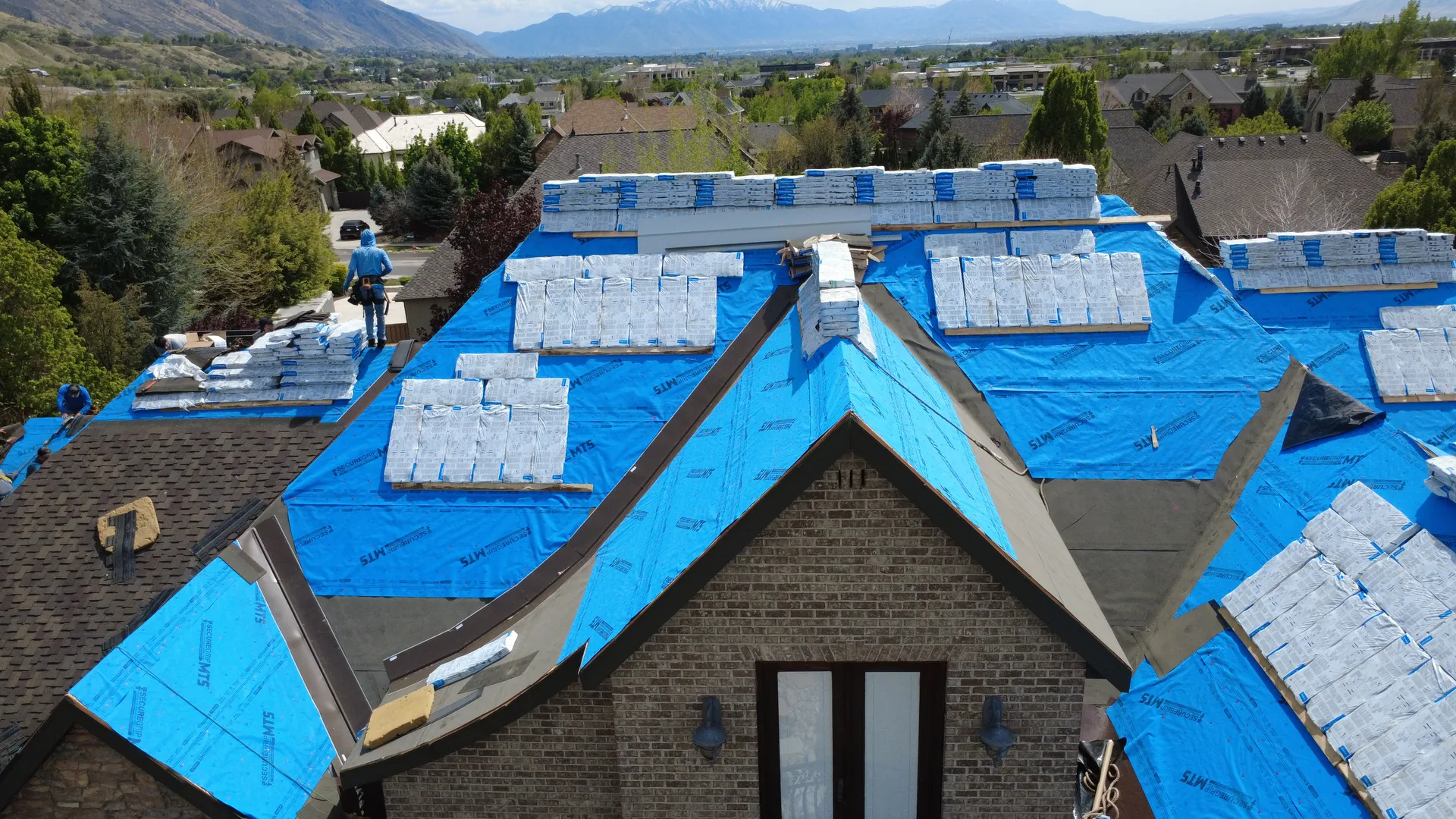
3. Underlayment and ice-and-water shield. This is the most-skipped line on cheap quotes and the most expensive failure mode when it's wrong. Synthetic underlayment is now standard; 30-pound felt is acceptable but inferior. Ice-and-water shield is required by International Residential Code R905.1.2 to extend at least 36 inches past the interior wall line in cold-climate Utah — that's all of it. At elevations above roughly 6,500 feet (Park City, parts of Heber, mountain pockets of Cottonwood Heights), full-deck ice-and-water shield is the right call regardless of code minimum. A quote that omits ice-and-water shield entirely is non-compliant; a quote that lists it as 36 inches at the eaves only on a 5,500-foot home is technically code-minimum but lifecycle-suboptimal.
4. Shingles, ridge cap, and material tier. Quote should specify product line, tier (3-tab, architectural, designer, or impact-resistant Class 4), color, and warranty length. "30-year shingles" is not specific enough — there are huge quality differences between manufacturers' 30-year products. We do not install 3-tab in 2026 because the wind-uplift rating (60 mph) is below typical Utah gust speeds. Class 4 impact-resistant architectural shingles cost 15 to 20 percent more but qualify for a 10 to 30 percent insurance discount on the wind-and-hail premium portion with most Utah carriers — the discount typically pays back the upgrade in 4 to 6 years. The ridge cap should match the shingle profile and be priced separately or noted as included.
5. Flashing, pipe boots, and vents. This is where storm-chaser quotes leak — the line items they skip to come in low. Step flashing along sidewalls, chimney counter-flashing, plumbing-vent pipe boots, and bath-vent boots all need replacement on a full reroof. Pipe boots in particular fail on a 10-to-12-year cycle and are the single most common post-reroof leak point when a contractor reuses the existing ones to save $200. Bath-vent boots fail faster at Utah elevation due to UV exposure. A complete quote lists each of these as discrete items with specific quantities ("3 plumbing pipe boots" rather than "flashing as needed").
6. Labor, cleanup, and magnetic-sweep. Labor should be itemized rather than bundled into a vague "installation allowance." Cleanup is real cost — multiple passes during the job plus a final magnetic sweep of the lawn and driveway to capture stray nails. A quote that lists $0 for cleanup is either hiding the cost in another line or planning to skip it entirely (and you'll find nails in your tires for the next year). Magnetic-sweep specifically separates real contractors from out-of-state storm-chasers; ask for it explicitly and confirm it's in writing.
7. Permit and workmanship warranty. Utah city permit fees range from roughly $150 in smaller municipalities to $500-plus in Park City for larger reroofs. Permit fees are passed through; a quote omitting them is either including the cost without breaking it out or planning to skip pulling the permit (which voids most insurance coverage on the new roof). Workmanship warranty terms must be in writing — Frame's standard is 10 years on workmanship; the industry average is 5 years. Manufacturer material warranty (typically 25 to 50 years) is separate and depends on the product line. A quote without explicit warranty terms is a quote without warranty.
Insurance Quote Anatomy: RCV, ACV, RFG300, and O&P
Insurance-funded reroofs run on a different language than cash quotes. Most Utah homeowner policies pay claims on Replacement Cost Value (RCV) basis — the carrier pays full replacement cost minus your deductible, with depreciation withheld at first payment and released after the work is complete and you submit proof of payment. Older policies and some specific scenarios pay on Actual Cash Value (ACV) — depreciated value only, no withhold-and-release mechanism. ACV typically pays 50 to 70 percent of replacement cost on a 15-year-old roof, which often leaves homeowners with significant out-of-pocket costs even after deductible.
Insurance carriers price line items using Xactimate, an industry-standard estimating software. Xactimate codes look like alphanumeric strings — RFG300 means "remove and replace 30-pound felt underlayment, per square," RFG240 means "remove and replace 240-pound 3-tab shingles, per square," RFG300SM means "30-pound felt with synthetic mesh upgrade." When you see these codes on an insurance estimate, your roofer should be able to translate each one. If they cannot or will not, that is itself a flag — Xactimate fluency is table stakes for any contractor handling claim work in Utah.
Overhead and Profit (O&P) is typically 10 percent overhead plus 10 percent profit, sometimes shown as a combined 20 percent line at the bottom of an estimate. Insurance industry guidelines (specifically the "three-trade rule") only require carriers to add O&P when three or more separate trades are involved (e.g., roofing plus drywall plus painting after interior leak damage). On a roofing-only claim, carriers often initially exclude O&P; reasonable supplements can capture it when the project complexity actually requires general-contractor coordination. See our insurance claim process for a step-by-step homeowner guide.
The Walk-Away Red Flags
Some quote patterns are reliable warning signs that the contractor is either inexperienced, cutting corners, or both. Walk away from any quote that exhibits these patterns: (1) No permit fee line item — either the contractor doesn't pull permits (voids insurance), or they're hiding the cost. (2) No underlayment or ice-and-water shield line item — code violation in cold-climate Utah, will fail at first ice dam. (3) Vague "labor allowance" instead of itemized labor — pricing-pressure structure, not a real quote. (4) Verbal estimate only with no signed PDF — you have no recourse when scope changes mid-project.
Continuing: (5) Pressure to sign today, or "this price expires at 5pm" — high-pressure tactics are the signature of out-of-state storm-chasers who descend on Utah after every major hail event. Real contractors give you time to compare. (6) Missing license number, certificate of insurance reference, or surety bond reference — verify Utah DOPL licensing at dopl.utah.gov before agreeing to any work. Frame Roofing Utah's DOPL license is 14256097-5501; any reputable Utah contractor will provide their number on the first request. (7) Deposit greater than 10 percent — Utah does not require any deposit by law; reasonable deposits are 0 to 10 percent at scheduling, with progress payments tied to completion milestones. (8) No workmanship warranty terms in writing — the warranty is part of the deliverable.
Two more subtle patterns worth flagging: a quote that comes in 25 percent below all other bids on identical scope is almost always missing line items rather than offering a genuine discount, and a quote that requires you to sign an Assignment of Benefits (AOB) before they file your insurance claim hands the contractor control of your settlement. AOBs are legal in Utah but heavily abused by storm-chasers; sign one only if you have explicit reason to and your attorney has reviewed it.
A Sample 2026 Wasatch Front Quote Breakdown
Here is what a fair, complete quote looks like for a typical 30-square architectural-shingle reroof in Salt Lake County in mid-2026 dollars. Tear-off and disposal: $1,800 to $2,400. Decking allowance at $90 per sheet (4-sheet baseline, $360, with a $90 per-sheet change-order rate for additional rot found): $360 base. Synthetic underlayment plus 36-inch ice-and-water shield to code: $900 to $1,300. Architectural shingles plus ridge cap (CertainTeed Landmark 30-year or equivalent): $5,200 to $7,200. Step flashing, chimney counter-flashing, plumbing pipe boots (3 boots), bath-vent boots: $700 to $1,100. Drip edge and starter strip: $300 to $450. Labor and cleanup (3-person crew, 1.5 days, including magnetic sweep): $2,800 to $3,900. Permit fee (varies by city, $200-$350 typical): $275. Total range: $12,335 to $17,975. Add 15 to 20 percent for Class 4 impact-resistant upgrade. Add 30 to 60 percent for full standing-seam metal.
These numbers are mid-2026 Wasatch Front baseline. Cottonwood Heights, Park City, Heber, Alpine, and other east-bench or higher-elevation cities run 8 to 18 percent above this baseline due to elevation premium, full-deck ice-and-water shield specs, and HOA design covenants that often mandate Class A material upgrades. Cities like Murray, West Valley, and Orem on the valley floor often come in at the lower end of the range. See our full Utah roof replacement cost guide for city-by-city pricing and material-tier breakdowns.
These ranges assume single-layer tear-off and standard 4/12 to 8/12 pitch. Multi-layer tear-offs (asphalt over wood shake on pre-1975 homes) add 10 to 18 percent. Steep pitches (10/12 and above, common in Park City and Bell Canyon) add 15 to 25 percent due to safety equipment and labor hours. Complex roofs with multiple valleys, dormers, or specialty intersections add 10 to 20 percent. Get at least three quotes from licensed Utah contractors and compare line-by-line — not bottom-line-to-bottom-line.
What to Ask Before You Sign
Six questions every homeowner should ask before signing a roofing contract: (1) What is your Utah DOPL license number, and can I see your current certificate of insurance? Verify both at dopl.utah.gov before you sign. (2) What's your decking change-order procedure if you find more rot than the allowance covers? Look for a clear per-sheet rate and a notice-and-approval process, not "we'll bill what we use." (3) Is magnetic-sweep guaranteed in writing, and how many passes? Real answer: at least one final pass after cleanup. (4) What are the workmanship warranty terms and the manufacturer material warranty? Get both in writing with specific year counts and what voids each.
Continuing: (5) What's the payment milestone schedule? Reasonable: 0 to 10 percent at scheduling, balance at substantial completion or after final inspection passes. Unreasonable: any structure that pays more than 50 percent before tear-off. (6) Can you provide three references in my specific city or neighborhood? A licensed Utah contractor with current customers in your area is verifiable; an out-of-state storm-chaser typically cannot or will dodge. We provide neighborhood-specific references on request as part of every Frame Roofing Utah quote.
How Frame Roofing Utah Quotes Differ
Frame Roofing Utah provides written, line-item PDF estimates within 24 to 48 hours of an on-site inspection — not same-day verbal quotes, not three-day hold-the-price tactics. Every line we install meets Utah DOPL contractor licensing standards, IRC R905 specifications, and the manufacturer's installation requirements (which is what activates the material warranty).
Standard inclusions on every Frame quote: full tear-off and disposal, decking inspection with $90/sheet replacement allowance plus a clear per-sheet change-order procedure, synthetic underlayment plus IRC R905.1.2-compliant ice-and-water shield (full-deck on homes above 5,500 ft elevation), the specified shingle product line with manufacturer warranty registration on your behalf, all flashing and pipe boots and vents, labor and cleanup with magnetic-sweep included, the city building permit fee, and our 10-year workmanship warranty document issued at project close. Verify our Utah DOPL license, BBB accreditation, and insurance coverage.
What we don't do: same-day-close pricing, AOB-required structures, deposits above 10 percent, or quotes without specific line-item breakdowns. Free on-site inspection and written estimate within 48 hours, no obligation. Schedule by calling 435-302-4422 or book your free Utah roof inspection online.
Frequently Asked Questions
What should be included in a Utah roof replacement quote?
A complete Utah roof replacement quote should include seven line items: (1) tear-off and disposal, (2) decking inspection plus replacement allowance with a per-sheet rate for change orders, (3) underlayment plus IRC R905.1.2-compliant ice-and-water shield (3 feet past the interior wall in cold-climate Utah, full-deck above 6,500 ft elevation), (4) shingles plus ridge cap with specific product and warranty, (5) flashing plus pipe boots plus vents listed as discrete items, (6) labor plus cleanup with magnetic-sweep, and (7) city permit fee plus workmanship warranty terms in writing. Quotes missing the underlayment, flashing, or permit lines are change-order ambushes.
What is RFG300 on an insurance roof replacement claim?
RFG300 is an Xactimate code meaning "remove and replace 30-pound felt underlayment, per square." Insurance carriers price claims using Xactimate, the industry-standard estimating software, and the codes appear as alphanumeric line items on adjuster estimates. Common Utah claim codes include RFG300 (felt underlayment), RFG240 (240-pound 3-tab shingle remove and replace), RFG300SM (felt with synthetic mesh upgrade), and many flashing and accessory codes. Your roofer should translate each Xactimate code on your estimate; if they cannot or will not, that is a competence flag.
What's a reasonable Overhead and Profit (O&P) percentage on a Utah roofing quote?
Industry standard is approximately 10 percent overhead plus 10 percent profit, sometimes shown as a combined 20 percent line at the bottom of an estimate. On insurance claims, the "three-trade rule" guideline specifies that carriers add O&P when three or more separate trades are involved (roofing plus drywall plus painting after interior leak damage, for example). On a roofing-only claim, carriers often initially exclude O&P, but reasonable supplements can capture it when project complexity actually requires general-contractor coordination. On a straight cash quote, the markup is usually built into individual line items rather than shown separately.
Is $72,000 a reasonable price for a roof replacement in Utah?
It depends entirely on size, material tier, and complexity. A $72,000 quote on a typical 30-square (3,000 square foot) residential home works out to roughly $24 per square foot installed, which is premium territory: full standing-seam metal on a steep pitch with significant decking replacement, designer shake (synthetic or natural), or a multi-story custom home with complex valleys and HOA-mandated specialty materials. Average Wasatch Front replacement on a typical 30-square architectural-shingle reroof runs $12,000 to $18,000. If your home is a typical valley single-story and the quote is $72,000, ask for the line-item breakdown and compare against the components in this guide.
What red flags should I watch for in a roofing quote?
Walk away from any quote with: no permit fee line item, no underlayment or ice-and-water shield line item, vague "labor allowance" instead of itemized labor, verbal estimate only with no signed PDF, pressure to sign today ("this price expires at 5pm"), missing license number or certificate of insurance reference, deposit greater than 10 percent, no workmanship warranty terms in writing, or any required Assignment of Benefits before claim filing. A quote running 25 percent below all other bids on identical scope is almost always missing line items, not offering a genuine discount.
Sources & References
- International Residential Code R905 (roof coverings)
- Utah Division of Professional Licensing (DOPL)
- Utah Insurance Department
- UL 2218 Impact Resistance Standard (Class 4 shingles)
- Better Business Bureau — Utah
Frame Roofing Utah serves homeowners across the Wasatch Front and Heber Valley with free post-storm and pre-purchase inspections. Call 435-302-4422 or schedule online. Every repair is backed by our 10-year workmanship warranty.