QUICK ANSWER: South Jordan splits into two distinct reroof markets: the original town-center neighborhoods around Redwood Road and 10400 South (1960s-80s housing now on second-cycle reroof), and the master-planned Daybreak community (2004-present, with strict architectural design covenants requiring HOA approval for any visible exterior change). Both markets need different scoping. Frame Roofing Utah handles HOA submittals, Salt Lake County permits, and insurance coordination as part of every scope. Licensed, insured, BBB Accredited (A+), free on-site assessments, 10-year workmanship warranty. Call 435-302-4422.
Why South Jordan Splits Into Two Different Reroof Markets
South Jordan is geographically and demographically two cities sharing one municipal boundary. The original town-center neighborhoods around Redwood Road and 10400 South were built between 1960 and 1985 as a Salt Lake County agricultural-residential community. Most of those homes are now on second-cycle reroof, often with original wood shake under one or more layers of later asphalt. Class A material requirements apply citywide per Salt Lake County code, but neighborhood-level design covenants are minimal in this area.
Daybreak — the master-planned community covering most of the southwestern half of the city — is a completely different reroof market. Built from 2004 to present by Kennecott Land (now Larry H. Miller Real Estate), Daybreak operates under a detailed Community Charter and Design Guidelines administered by the Daybreak Community Council. Any visible exterior change including reroofs requires Architectural Review Committee submittal and approval. Material specs, color palettes, profile types, and even ridge-cap appearance are governed by the design guidelines.
The practical consequence: a contractor familiar only with the town-center side of the city will under-scope a Daybreak reroof by 15 to 25 percent and miss the HOA submittal timeline entirely, which adds 2 to 4 weeks to the project cycle. We work both sides of the city and adjust process accordingly.
Daybreak Reroof Considerations
Daybreak's design guidelines specify acceptable roofing materials for each village (Founders Village, Kennecott Village, Daybreak Village, the Watercourse area, etc.), with most villages allowing Class A architectural asphalt, designer shake, and standing-seam metal in approved color palettes. Three-tab asphalt is universally disallowed. Color shifts and profile changes from the original installed material need full design-review submittal regardless of whether the new product otherwise meets the spec.
Daybreak homes range from 2004 (oldest) to present-day new construction. The 2004-2010 homes are now at 15 to 21 years old — first-cycle reroof window for the original 25-30 year asphalt installed by the original developer. Most of these homes received builder-grade architectural shingles which are reaching functional end-of-life under Utah's UV and wind exposure ahead of their rated lifespan. Class 4 impact-resistant architectural is typically the right upgrade because it matches the visual aesthetic Daybreak design review approves and qualifies for the Utah carrier insurance discount.
The Daybreak Architectural Review Committee processes most submittals in 2 to 4 weeks. Like-for-like material with matching color clears at the lower end. Material changes (asphalt to metal, color shift outside the village palette) take longer and may require additional documentation. Frame Roofing Utah handles the full submittal as part of any Daybreak scope. See full reroof material specs and pricing.
Town Center and Glenmoor Estates Reroofs
The town-center neighborhoods around 10400 South and Redwood Road carry South Jordan's oldest housing stock — 1960s-80s ranchers, split-levels, and farmhouses. Most are on second or sometimes third reroof cycle now. The dominant reroof scope here is full tear-off including any layered shingle assemblies (asphalt over original wood shake is common in homes built before 1975), full deck inspection, and replacement of any rotted sheathing. Original galvanized flashing and pipe boots from 1970s-80s installs almost always need replacement.
Glenmoor Estates and similar small HOA pockets along the eastern edge of the city carry CC&Rs requiring Class A 30-year-warranty materials with architectural review for material changes. These submittal processes are simpler than Daybreak (typically 1 to 2 weeks rather than 2 to 4) but still need to be factored into the project timeline. River Heights and the older non-HOA neighborhoods south of the town center are the most flexible scope-wise — material choice is governed by Salt Lake County code only.
Class 4 impact-resistant architectural asphalt is the right baseline for most town-center and Glenmoor reroofs, with the same insurance-discount math (10 to 30 percent off wind-and-hail premium with most Utah carriers) recouping the upfront premium in 4 to 6 years. Standing-seam and designer shake are over-spec for most of the town-center housing demographic but appropriate on River Heights estate properties.
What a South Jordan Reroof Actually Costs
South Jordan reroof pricing varies more by neighborhood than most Utah cities because of the Daybreak-vs-town-center split. Basic ranges for a typical 30-square home in 2026 dollars: standard 30-year architectural asphalt runs roughly $12,000 to $18,000; Class 4 impact-resistant architectural runs $14,000 to $21,000; designer shake (synthetic) runs $24,000 to $40,000; standing-seam metal runs $30,000 to $54,000.
Daybreak homes typically run 8 to 15 percent higher on the same scope because of HOA-mandated material specs (no 3-tab, sometimes specific color palettes that limit price negotiation), HOA submittal fees (typically $50-$150 per submittal, paid by homeowner), and the longer project cycle (extra 2 to 4 weeks for HOA approval adds carrying-cost overhead). Town-center reroofs without HOA constraints typically come in at the lower end of the range. River Heights estate properties with specialty materials can reach the upper end.
Financing is available for qualified homeowners through standard third-party lenders, and we work with all major Utah homeowner-insurance carriers when storm damage justifies a claim-funded replacement. See our insurance-claim process for storm-funded reroofs.
The Frame Roofing Utah Reroof Process
Every reroof starts with a free, no-obligation on-site inspection. Our crew documents the existing roof condition with annotated photos, measures every plane, identifies decking issues that may need replacement, and provides a written estimate within 24 to 48 hours. We work to current International Residential Code (IRC R905) standards and Utah DOPL contractor licensing requirements. Every reroof includes our 10-year workmanship warranty plus the manufacturer's material warranty.
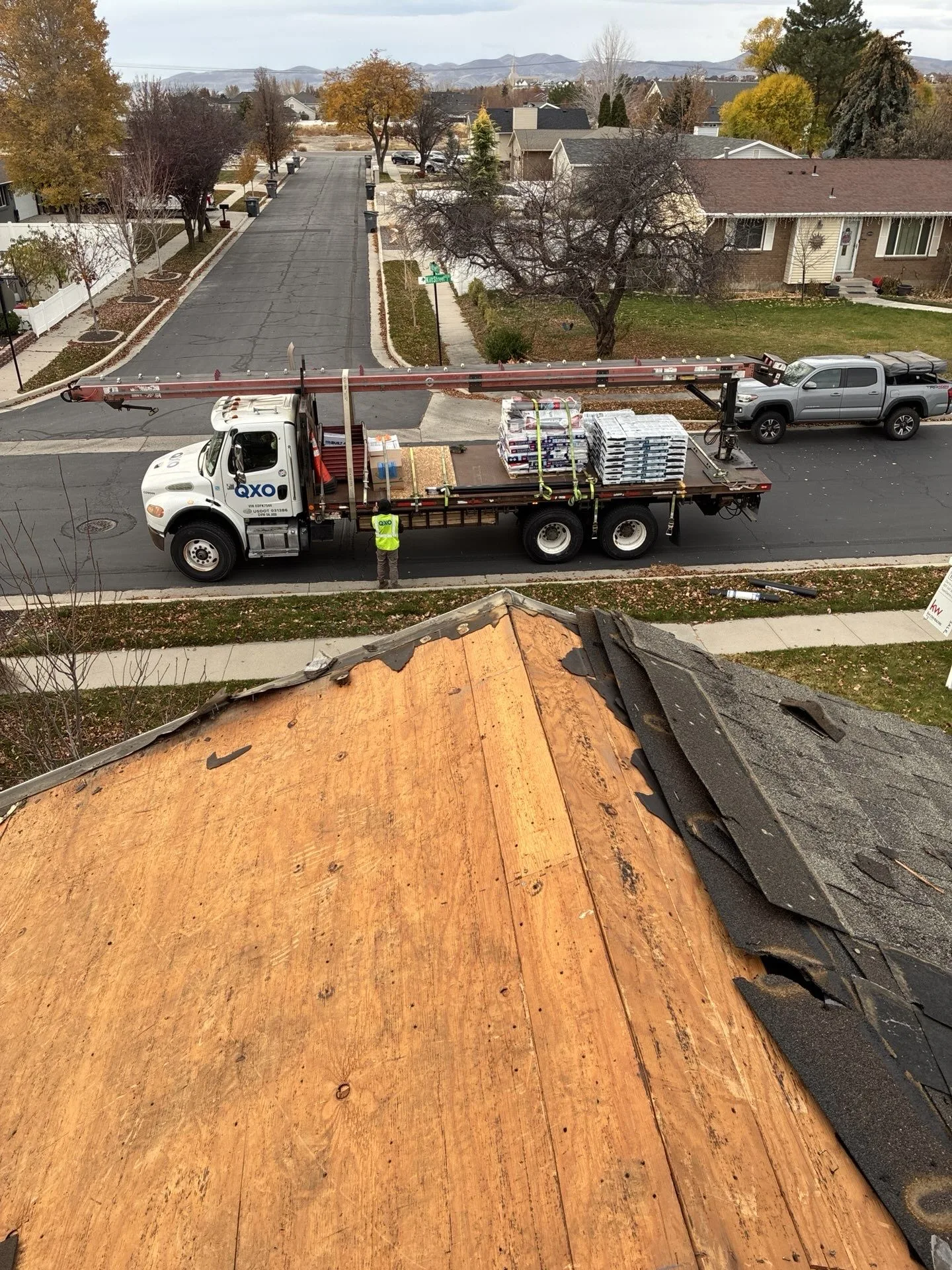
On install day we tear off to the deck, inspect every sheet for rot or delamination, install ice-and-water shield to local code, install synthetic underlayment, install drip edge and starter strip, install the finished roofing material per design-guideline specifications where applicable, install ridge venting and ridge cap, replace all pipe boots and step flashing. Standard crew completes a 30-square asphalt reroof in 1 to 2 days; specialty-material reroofs run 4 to 7 days. Verify our Utah DOPL license and BBB accreditation.
Throughout the project we coordinate with the Daybreak Architectural Review Committee or relevant HOA (where applicable), the South Jordan City building department on permits, and your insurance adjuster if the reroof is claim-funded. The Daybreak submittal process is the most complex of any Utah city we work in — homeowners do not need to manage any of this directly.
Frequently Asked Questions
Does my Daybreak home need Architectural Review Committee approval for a roof replacement?
Yes. The Daybreak Community Charter and Design Guidelines require ARC submittal for any visible exterior change including reroofs. Like-for-like material with matching color from the village palette typically clears in 2 to 3 weeks. Material changes (asphalt to metal, color shift outside the palette) take 3 to 4 weeks. Frame Roofing Utah handles the submittal as part of every Daybreak scope. ARC submittal fees are typically $50-$150.
What's the difference between Daybreak and town-center South Jordan reroof scoping?
Three big differences. Material specs: Daybreak design guidelines mandate Class A materials in approved village palettes; town-center is governed by Salt Lake County code only. HOA timeline: Daybreak adds 2 to 4 weeks for ARC approval; town-center has none unless in Glenmoor Estates or similar HOA pockets (1 to 2 weeks). Cost: Daybreak runs 8 to 15 percent higher on identical scope due to material constraints, submittal fees, and carrying-cost overhead from the longer cycle.
My South Jordan home is from 1972 with multiple shingle layers — is that a problem on the reroof?
It's standard scope for older South Jordan town-center homes. Asphalt over original wood shake is common in pre-1975 housing. The reroof scope needs full tear-off to the deck (one layer at a time), full deck inspection for rot and delamination, and likely replacement of original galvanized flashing and pipe boots. Budget 2 to 6 sheets of decking replacement on most multi-layer tear-offs. Total cost typically runs 10 to 18 percent higher than a single-layer tear-off.
Can I install Class 4 impact-resistant shingles in Daybreak?
Yes, in most villages — Class 4 impact-resistant architectural (CertainTeed NorthGate, GAF Timberline AS II, Owens Corning Duration Storm) is approved as like-for-like aesthetic in the Daybreak villages that allow architectural asphalt. The submittal still requires color confirmation against the village palette. The insurance discount typically recoups the upfront premium in 4 to 6 years, making Class 4 the smart upgrade for Daybreak first-cycle reroofs.
How long does a roof replacement take in South Jordan?
Standard architectural-asphalt reroofs install in 1 to 2 days. Specialty-material reroofs (designer shake, standing-seam) run 4 to 7 days. Daybreak HOA submittal adds 2 to 4 weeks. Glenmoor Estates and similar smaller HOAs add 1 to 2 weeks. Town-center reroofs without HOA add no additional cycle. South Jordan City building department permits typically take 5 to 10 business days. Total project cycle from scope-lock to final inspection: 2 to 4 weeks town-center, 5 to 8 weeks Daybreak.
Sources & References
- South Jordan City — Building Department
- Daybreak Community — Design Guidelines
- International Residential Code R905
- Utah Division of Professional Licensing (DOPL)
- Utah Insurance Department
Frame Roofing Utah serves homeowners across the Wasatch Front and Heber Valley with free post-storm and pre-purchase inspections. Call 435-302-4422 or schedule online. Every repair is backed by our 10-year workmanship warranty.