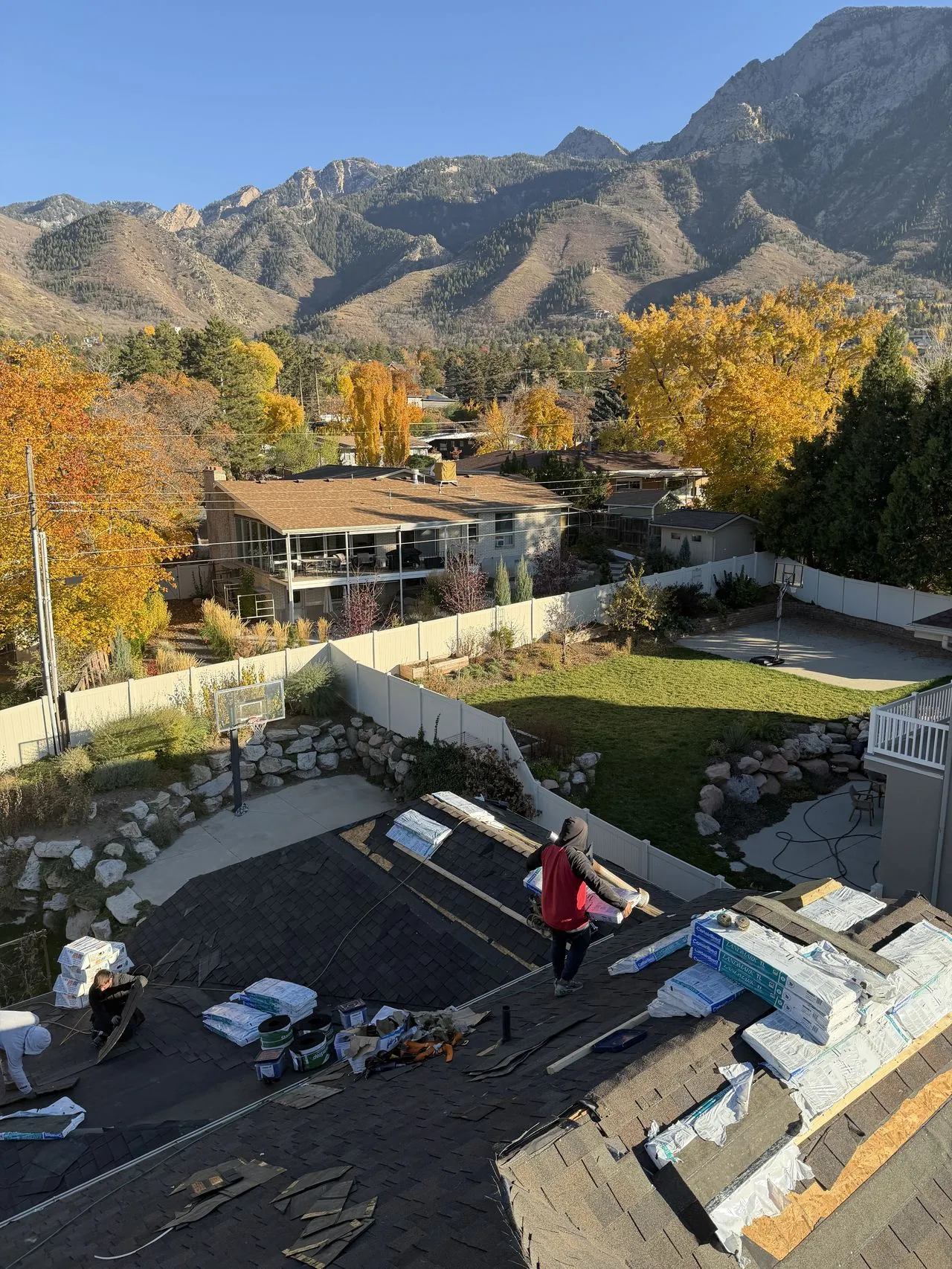
QUICK ANSWER: Most asphalt roofs in Cottonwood Heights need replacement at 22 to 28 years — sooner than the same product in valley cities — because the city's 4,500 to 5,500 ft elevation produces more aggressive freeze-thaw cycles, harder UV exposure on south-facing planes, and routine 60+ mph canyon-outflow gusts off Big Cottonwood Canyon. The right reroof scope for a CH home depends on neighborhood: Top of the World and Bell Canyon homes typically warrant standing-seam or designer-shake under HOA design rules; Old Cottonwood ramblers along Bengal Boulevard fit Class 4 impact-resistant architectural asphalt. Frame Roofing Utah is licensed, insured, BBB Accredited (A+), with free on-site assessments and a 10-year workmanship warranty. Call 435-302-4422.
Why Cottonwood Heights Roofs Wear Faster than Valley Roofs
Cottonwood Heights sits on the Wasatch east bench between roughly 4,500 feet at its western edge and 5,500+ feet in the Top of the World and Bell Canyon corridors. That 1,000-foot elevation range produces a measurably different roof-aging profile than valley cities like Murray or West Valley, even on the same product line. South-facing planes at 5,000+ feet receive harder UV, freeze-thaw cycles routinely swing 40 to 50 degrees in a single April day, and the city's position at the mouth of Big Cottonwood Canyon exposes roofs to 60 to 80 mph outflow gusts during frontal passages — well above the design-load failure threshold for any asphalt shingle older than 10 years.
The practical consequence: a 30-year architectural shingle that performs to its rated lifespan in West Valley typically reaches end-of-life at 22 to 28 years on a Cottonwood Heights east-bench home. The most common failure pattern we see on first-cycle CH reroofs is granule loss along south and west planes, brittle seal strips that broke during a wind event two or three winters earlier and reseated, and ridge-cap migration. None of these are visible from a ground inspection without binoculars.
Most of the city's housing stock was built between 1960 and 1995, which means a large share of CH homes are on their first reroof cycle right now. The original 1980s-90s 3-tab asphalt is well past warranty. The 2000s-era architectural asphalt is approaching the warranty cliff. If your CH home is in this window and you have not had a professional inspection in the last two years, you are likely overdue.
Material Choices that Actually Hold Up at CH Elevation
Standard 3-tab asphalt is not appropriate for Cottonwood Heights elevation in 2026 — the wind-uplift rating (60 mph) is below typical canyon-outflow gust speeds, and the warranty period (15-20 years) is shorter than the practical service life at this elevation. We do not install 3-tab on CH homes. The baseline minimum we install is 30-year architectural asphalt with a 110+ mph wind warranty.
Class 4 impact-resistant shingles are the smartest mid-tier upgrade for most CH homes. They cost about 15 to 20 percent more than standard architectural shingles but qualify for an insurance discount with most Utah carriers (typically 10 to 30 percent off the wind-and-hail portion of premium), and they routinely outlast standard shingles by 5 to 10 years under CH UV and hail exposure. Common Class 4 product lines we install include CertainTeed NorthGate, GAF Timberline AS II, and Owens Corning Duration Storm.
Standing-seam metal and synthetic-shake products (CertainTeed Landmark, F-Wave, Brava) are appropriate for higher-elevation CH homes, particularly Top of the World, Bell Canyon, and the eastern Granite Hollow / Sundance Estates pockets where pitches are steeper, snow loads are heavier, and HOA design covenants typically require Class A 30-year-warranty materials. Standing-seam in particular sheds snow more reliably than asphalt and can last 50+ years with minor maintenance — at this elevation, the lifecycle math usually favors metal even at 2x the upfront cost. See full reroof material specs and pricing.
Neighborhood-Specific Reroof Considerations
Top of the World and Bell Canyon homes face the highest combination of wind exposure and material-spec stakes in the city. The neighborhoods sit directly at the Wasatch face above 5,200 feet, absorb the strongest canyon-outflow gusts off Big Cottonwood, and most homes here are custom builds with steeper pitches, complex valleys, and existing standing-seam metal or designer-shake material specs. A like-for-like asphalt scope on these homes will be rejected by both the homeowner and any sub-neighborhood architectural review. Plan for higher material costs ($15 to $25 per square foot installed for standing-seam) and longer lead times on specialty products.
Old Cottonwood (along Bengal Boulevard between roughly 6800 and 7800 South) is the city's original 1950s-70s neighborhood. Most homes here are mid-pitch ramblers with simple roof geometry — straightforward reroof candidates at 30 to 40 squares each. Class 4 architectural asphalt is the right baseline; metal is overkill for the demographic and architecture. Watch for original galvanized pipe boots, undersized ridge venting, and 1970s-era wood-shake-under-asphalt assemblies that need full tear-off plus deck inspection.
Royal Oaks, Oak Forest, and the Granite Hollow corridor between roughly 6800 South 2300 East and 7200 South 2700 East represent the city's family-neighborhood middle. Housing stock is predominantly 1970s-90s with a mix of split-levels, two-stories, and ranches. Most homes here are on first-cycle reroof now. Class 4 architectural asphalt is again the right baseline; some Granite Hollow HOA pockets require Class A 30-year-warranty materials, which is worth verifying before scope-locking.
Sundance Estates and the upper Bengal Boulevard corridor have HOA architectural review boards that will scrutinize material changes during reroof. Like-for-like asphalt clears administratively in most cases. Visible upgrades — color shifts, profile changes, switch from asphalt to metal — typically need design review and a 1-to-2 week approval window. Frame Roofing Utah handles HOA submittals as part of any Sundance Estates or Bell Canyon scope so homeowners do not need to manage the design-review correspondence directly.
What a CH Reroof Actually Costs
Cottonwood Heights reroof pricing varies more than valley cities because of the elevation premium, neighborhood material requirements, and roof-complexity range. Basic ranges for a typical 30-square home in 2026 dollars: Class 4 architectural asphalt runs roughly $14,000 to $22,000; designer shake (synthetic) runs $26,000 to $42,000; standing-seam metal runs $32,000 to $58,000. These are full-tear-off, full-deck-replacement-where-needed, full-underlayment-system, complete-flashing-replacement scopes — not overlay-only repairs.
Two factors push CH numbers higher than the valley equivalent: full-deck ice-and-water shield is standard at 5,000+ feet elevation (vs valley R905.1.2 minimum of 36 inches past the wall line), and steeper Top of the World / Bell Canyon pitches require additional safety equipment and labor hours. We provide written, line-item estimates after an on-site inspection — no high-pressure same-day-close pricing tactics, which is one of the easiest ways to identify and avoid out-of-state storm-chaser contractors who descend on the east bench after wind events.
Financing is available for qualified homeowners through standard third-party lenders, and we also work with all major Utah homeowner-insurance carriers when storm damage justifies a claim-funded replacement. See our insurance-claim process for storm-funded reroofs.
When to Replace vs Repair on a CH Roof
The replace-vs-repair decision tilts toward replacement faster on CH homes than on valley equivalents because the elevation accelerates wear on the surrounding components, not just the shingles. A 22-year-old asphalt roof in CH has aged seal strips, brittle ridge cap, sun-cooked underlayment in unventilated attic zones, and 15-to-20-year-old pipe boots all approaching simultaneous failure. Patching a missing-shingle cluster on a roof at this stage typically buys 12 to 24 months at most before the next failure point opens up.
Repair makes sense on CH roofs under 15 years old with localized damage (one missing shingle from a wind event, a single failed pipe boot, an isolated flashing leak). Above 18 years and especially above 22 years, the math usually favors replacement. See our roof-repair scope and pricing. We provide a written replace-vs-repair recommendation as part of every free inspection.
The Frame Roofing Utah Reroof Process
Every reroof starts with a free, no-obligation on-site inspection. Our crew documents the existing roof condition with annotated photos, measures every plane, identifies decking issues that may need replacement, and provides a written estimate within 24 to 48 hours. We work to current International Residential Code (IRC R905) standards and Utah DOPL contractor licensing requirements. Every reroof includes our 10-year workmanship warranty plus the manufacturer's material warranty (30 to 50 years on architectural asphalt, 50+ years on standing-seam metal).
On the install day we tear off to the deck, inspect every sheet for rot or delamination and replace as needed (most CH first-cycle reroofs need 2 to 6 sheets), install full-deck ice-and-water shield, install synthetic underlayment, install drip edge and starter strip, install the finished roofing material, install ridge venting and ridge cap, replace all pipe boots and step flashing. Standard crew completes a 30-square asphalt reroof in 1 to 2 days; specialty-material reroofs run 4 to 7 days. Verify our Utah DOPL license and BBB accreditation.
Throughout the project we coordinate with your HOA architectural review board (where applicable), the Cottonwood Heights building department on permits, and your insurance adjuster if the reroof is claim-funded. Homeowners do not need to manage any of this directly. We schedule around CH east-bench weather windows so a tear-off does not start the day before the next 70 mph canyon outflow comes off the Wasatch — that scheduling discipline is one of the differences between a local Utah contractor and an out-of-state storm chaser.
Frequently Asked Questions
How long does a Cottonwood Heights asphalt roof actually last?
On a Cottonwood Heights east-bench home, 30-year architectural asphalt typically reaches end-of-life at 22 to 28 years rather than the rated 30 years. The 4,500 to 5,500 ft elevation produces harder UV on south-facing planes, more aggressive freeze-thaw cycles, and routine 60+ mph canyon-outflow gusts that compromise seal strips. Schedule a free inspection at year 18 to 20 and plan replacement around year 22 to 25 for most CH homes.
Do I need an HOA review for a roof replacement in Top of the World or Sundance Estates?
Yes for material upgrades, often no for like-for-like. Top of the World, Sundance Estates, and parts of the Bengal Boulevard corridor have HOA architectural review boards. Like-for-like asphalt-to-asphalt repairs typically clear administratively. Visible material changes (color shifts, profile changes, switch from asphalt to metal) need design-review approval, which usually takes 1 to 2 weeks. Frame Roofing Utah handles HOA submittals as part of the scope.
What's the difference between Class 3 and Class 4 impact-resistant shingles for Cottonwood Heights?
Class 4 is the highest rating in the UL 2218 impact test (steel ball survives a 2-inch drop without cracking the mat). Class 3 survives a 1.75-inch drop. The practical difference at CH elevation: Class 4 shingles routinely outlast Class 3 by 5 to 10 years under hail and wind exposure, and most Utah homeowner carriers offer a 10 to 30 percent insurance discount on the wind-and-hail premium portion for Class 4. The price premium over standard architectural is roughly 15 to 20 percent, which the insurance discount typically recoups within 4 to 6 years.
Why is a Cottonwood Heights reroof more expensive than the same job in West Valley or Murray?
Two real factors and one optional. Real factors: full-deck ice-and-water shield is standard at 5,000+ ft elevation (vs valley R905.1.2 minimum of 36 inches past the wall line), and steeper Top of the World and Bell Canyon pitches require additional safety equipment and labor hours. Optional factor: many CH homeowners spec material upgrades (Class 4, designer shake, standing-seam) that valley homeowners skip. The valley vs CH delta on identical scope is typically 8 to 15 percent; with material upgrades it can reach 60 to 100 percent.
How long does a roof replacement take in Cottonwood Heights?
A standard 30-square Class 4 architectural-asphalt reroof on a Royal Oaks or Old Cottonwood home runs 1 to 2 install days. Designer-shake or standing-seam reroofs on Top of the World or Bell Canyon homes run 4 to 7 days due to material complexity, steeper pitch, and sometimes specialty-product lead times. Add 1 to 2 weeks for HOA architectural review on visible material upgrades. Permit processing through the Cottonwood Heights building department typically runs 5 to 10 business days.
Sources & References
- Cottonwood Heights City — Building Department
- International Residential Code R905
- UL 2218 Impact Resistance Standard
- Utah Division of Professional Licensing (DOPL)
- National Weather Service — Salt Lake City
Frame Roofing Utah serves homeowners across the Wasatch Front and Heber Valley with free post-storm and pre-purchase inspections. Call 435-302-4422 or schedule online. Every repair is backed by our 10-year workmanship warranty.